
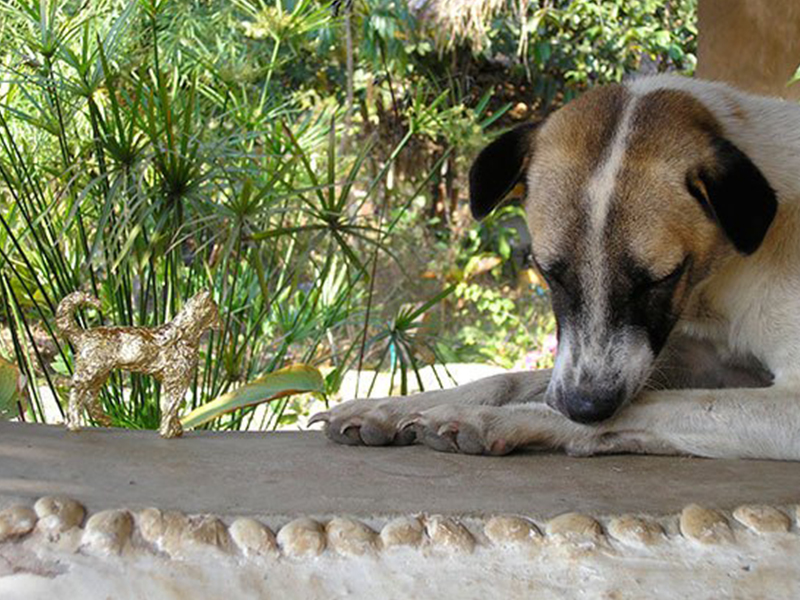
Golden dogs
Humans and dogs share a long and complex history. Dogs live with us, hunt for us, protect us and are feared by us. We treat them as commodities, belongings and friends. We ascribe them with human qualities and personalities, groom them, dress them and train them.
The Golden Dogs are small papier mâché objects covered with gold leaf. Many cultures create precious objects that are used as a way of focusing their spiritual thoughts. Growing up in a Catholic tradition I am interested in the similarities and differences I see in the use of sacred objects and relics in Buddhist traditions in Thailand. The idea of placing an icon of a dog into a temple niche and continuing this project internationally, grew out of an interest in thinking about the dog’s role in the contemporary world.
The series of Golden dogs I produced and photographed in Chiang Mai in January 2009 are early pieces in a work I intend to continue to develop over coming years in a range of places. This exercise is inspired by a larger collaborative project recently commenced with Helen Michaelsen called the Shiva project.
Over a number of years we have been discussing a range of issues associated with the way humans interact with and form relationships with dogs in different cultures. This work has been inspired by one dog in particular ”Shiva”, a white Thai dog, we originally met and shared a house with in Chiang Mai in 1994. Shiva has traveled with Helen to Europe and Australia as well as spending time living back in Thailand, and has inspired our current project.
Ellis Hutch
Shiva Project
Shiva epitomizes the finest qualities of a dominant female alpha dog, independent, intelligent, determined, persistent, persevering…and wise. She incorporates all qualities dogs have (in my understanding). Having lived in different cultures Shiva has accumulated diverse cultural knowledge, influencing how she has learned to interact with other dogs and with us human animals. In her early life as a street dog off Soi Wat Umong she acquired the street smartness as an essential tool for survival, the constant negotiation of blending in and being out there, the balancing act between being visible when in need of food and being invisible when harmful situations were looming. Knowing the rules of street territories with sectors and borders unrecognizable to us humans and yet so clearly understood by her and her street compatriots. The rules changed once she became a companion dog who belonged. With this belonging came new constraints and new freedoms. The safe intrusion into other dogs’ street territory thanks to human backup, the freedom from hunger, sleeping relaxed in a safe environment without having to be alert all the time, the freedom from ticks, bugs and worms. The loss of freedom to roam whenever and wherever. The loss of reproduction. The loss of the pack.
Dogs as an extension to human-defined culture to play out and confirm hierarchy, so inherent in all societies. Dogs as part of the family and/or child substitute for human affection. The so-called pet industry in the West is one of the 3 biggest industries, far from having reached its fullest potential yet.
I am convinced that these cultural denominators leave their invisible marks and visible scars on dogs, affecting dogs’ behavior amongst each other and their relationships to humans. The Shiva project pays tribute to this perception through explorations in Thailand, Germany and Australia. The project is dedicated to Shiva & Buddy and all the other wonderful dogs out there.
Helen Michaelsen